
YIMAPrivacy-first period calendar.
A privacy-first menstrual cycle calendar — no accounts, no cloud, no ads. A small tool designed without profit as a constraint, to see whether the experience can become good again.
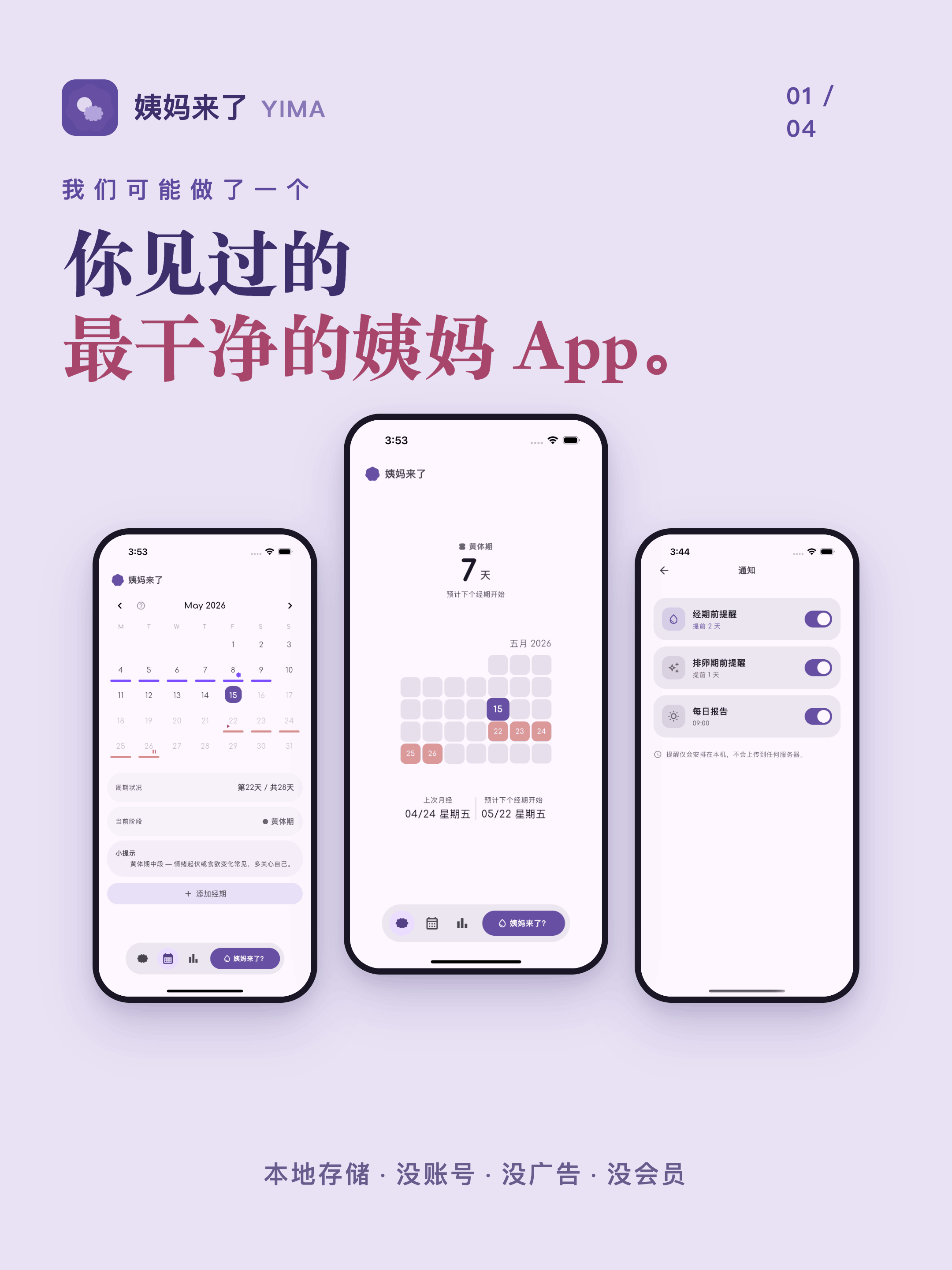 ▸ PF-002 · cover2026
Why this exists
Why we're building this
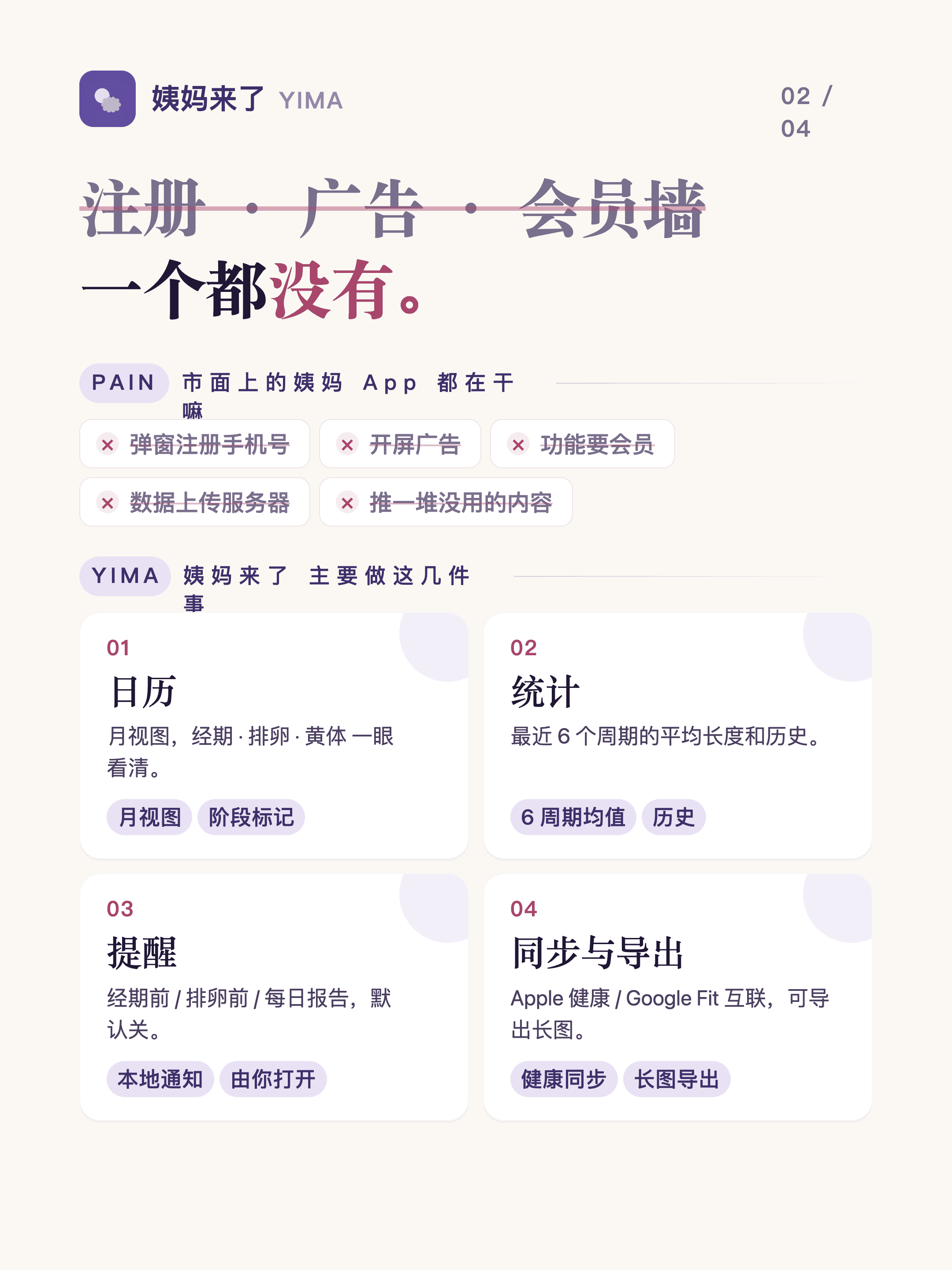
Most small utility apps used to be good. Somewhere along the way, the pressure to monetise turned them into something else — core features hidden behind paywalls, interfaces bloated with ads and upsells, settings pages that quietly exist to nudge you toward a subscription. The tool part of each app keeps shrinking; the wrapper around it keeps getting louder.
YIMA is a deliberate experiment in the other direction: design a small tool without profit as a constraint, and see whether the experience can become good again. No business model means no reason to compromise the core loop. No ads means no reason to keep you opening the app. No account means no reason to harvest data.
What's left is just the thing itself — a period tracker that tries to be genuinely useful, then gets out of your way.
Inside the app
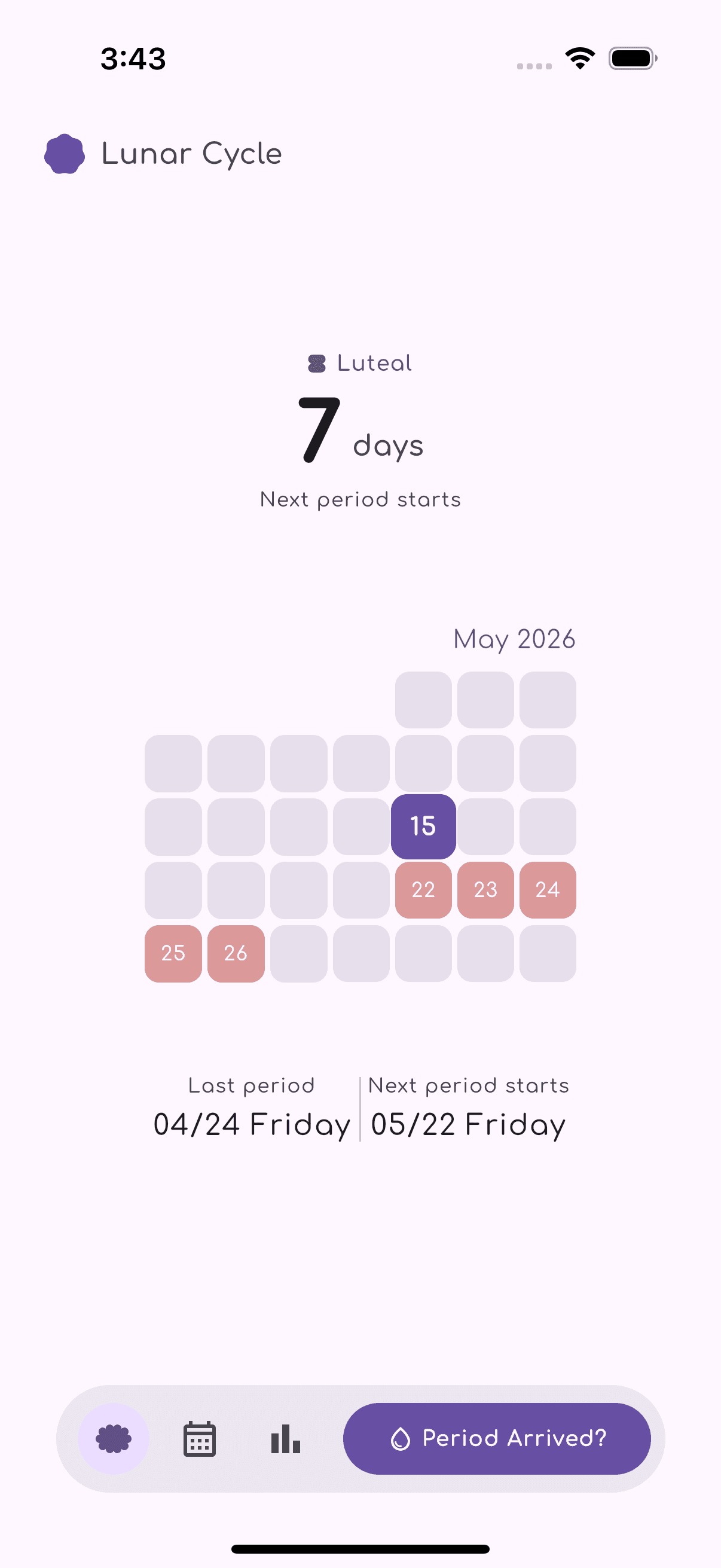
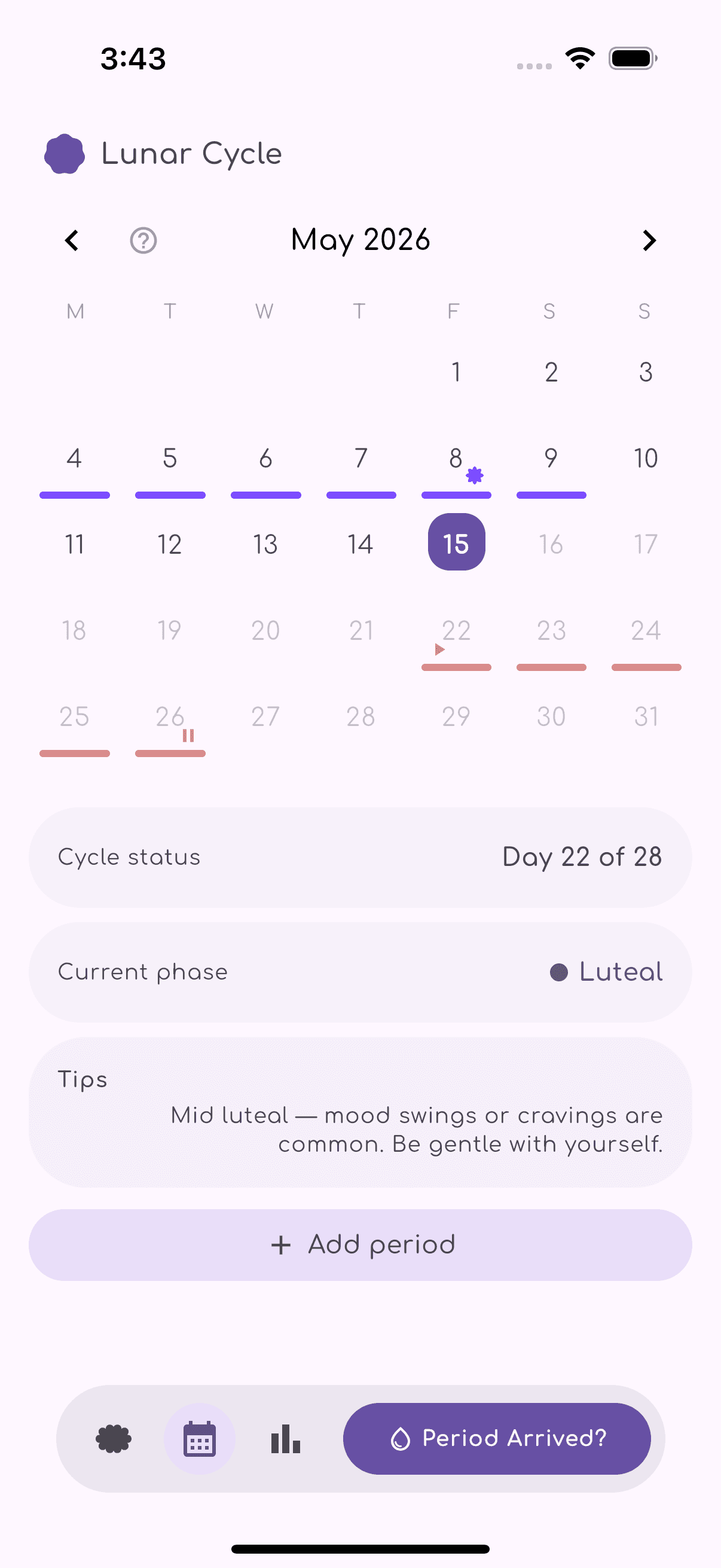
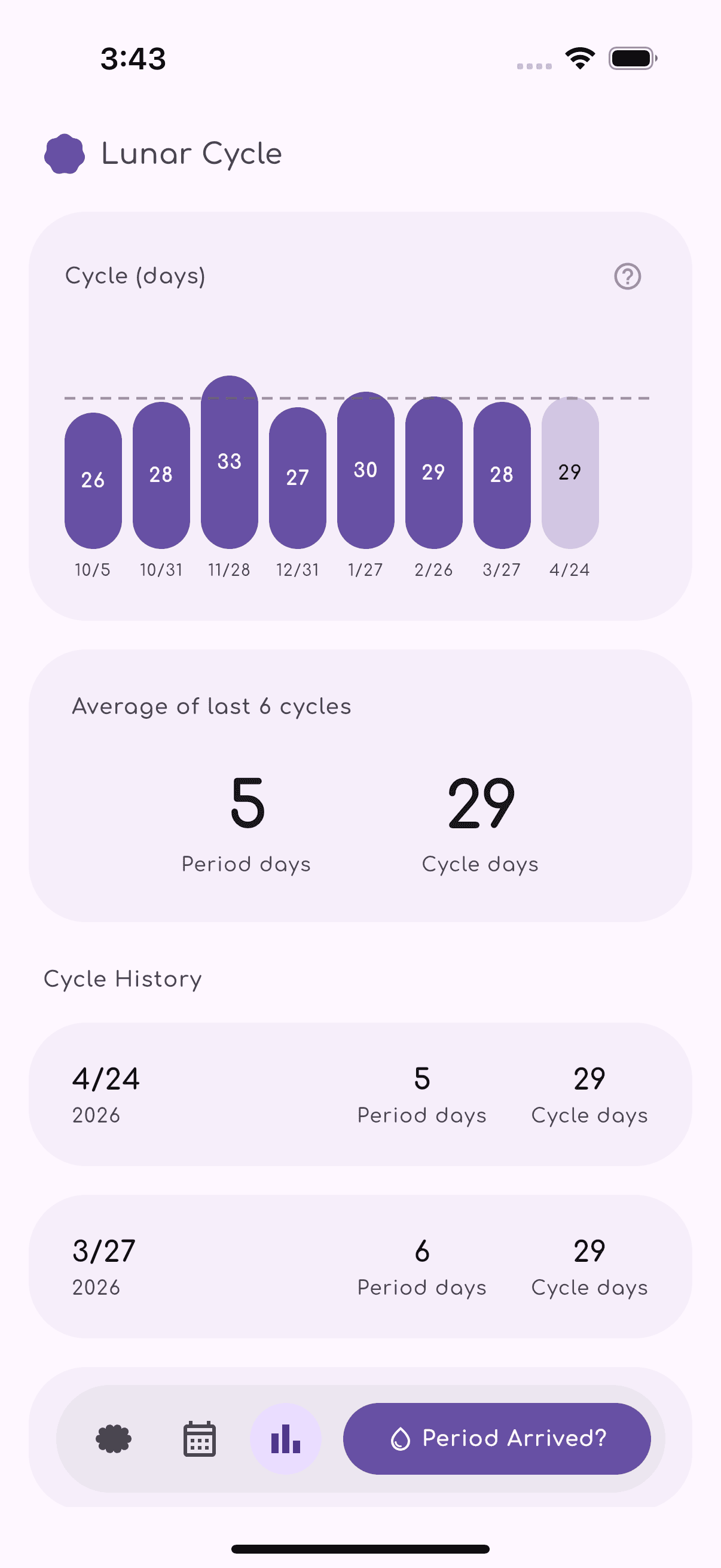
The home screen is three views, one tap away from each other:
- Overview — a large circular calendar of the current cycle, with the active phase called out
- Detail calendar — month-by-month, swipeable, with colour-coded period days, predicted days, ovulation window and an ovulation-peak marker
- Statistics — recent cycles as a bar chart with anomaly highlighting, plus rolling 6-cycle averages and the full record history
Logging is single-purpose and forgiving:
- One-tap "period arrived" / "period ended", with an estimated end date inferred from your own average and a smart auto-confirm if you forget to tap
- Backfill past periods by selecting a range on the calendar; edit any day in place from the detail view
- Per-day detail for flow intensity, mood, symptoms (cramps, back pain, headache, breast pain, fatigue) and free-text notes
Predictions are conservative on purpose:
- Three cycles forecast ahead, based on your own history
- Cycles shorter than 14 days are treated as anomalies and excluded from the average — a single irregular cycle doesn't drag the forecast around
- Four cycle phases (menstrual, follicular, ovulation, luteal) calculated with the medical count-back method, with a six-day fertile window
Two things many period apps don't ship cleanly:
- Apple Health & Google Health Connect — opt-in, bidirectional sync of menstrual period and flow data via HealthKMP, with overlap-safe import and write-back of manually logged periods
- Cycle report export — a single shareable long-image PNG containing your summary and every record with its daily logs; English or Chinese, picked independently of the app language; the native OS share sheet handles the file so YIMA never sees it
Notifications are opt-in and off by default — period reminder, ovulation reminder, daily reminder — each gated behind an explicit OS-level permission grant.
Onboarding sets your period length (2–10 days) and cycle length (20–45 days) with sliders, then auto-generates five past cycles using those settings so predictions and statistics work from day one.
Privacy by design
All cycle data lives in Jetpack DataStore on the device. No account, no sign-in, no phone number. No HTTP calls carry cycle data. No analytics, no trackers, no ads. The codebase is end-to-end auditable on GitHub.
Built with
Kotlin Multiplatform + Compose Multiplatform — single codebase, Android (SDK 26+) and iOS. Material Design 3 Expressive with Comfortaa typography. Full English and Simplified Chinese localisation. Bidirectional health sync via HealthKMP.
Where it lives
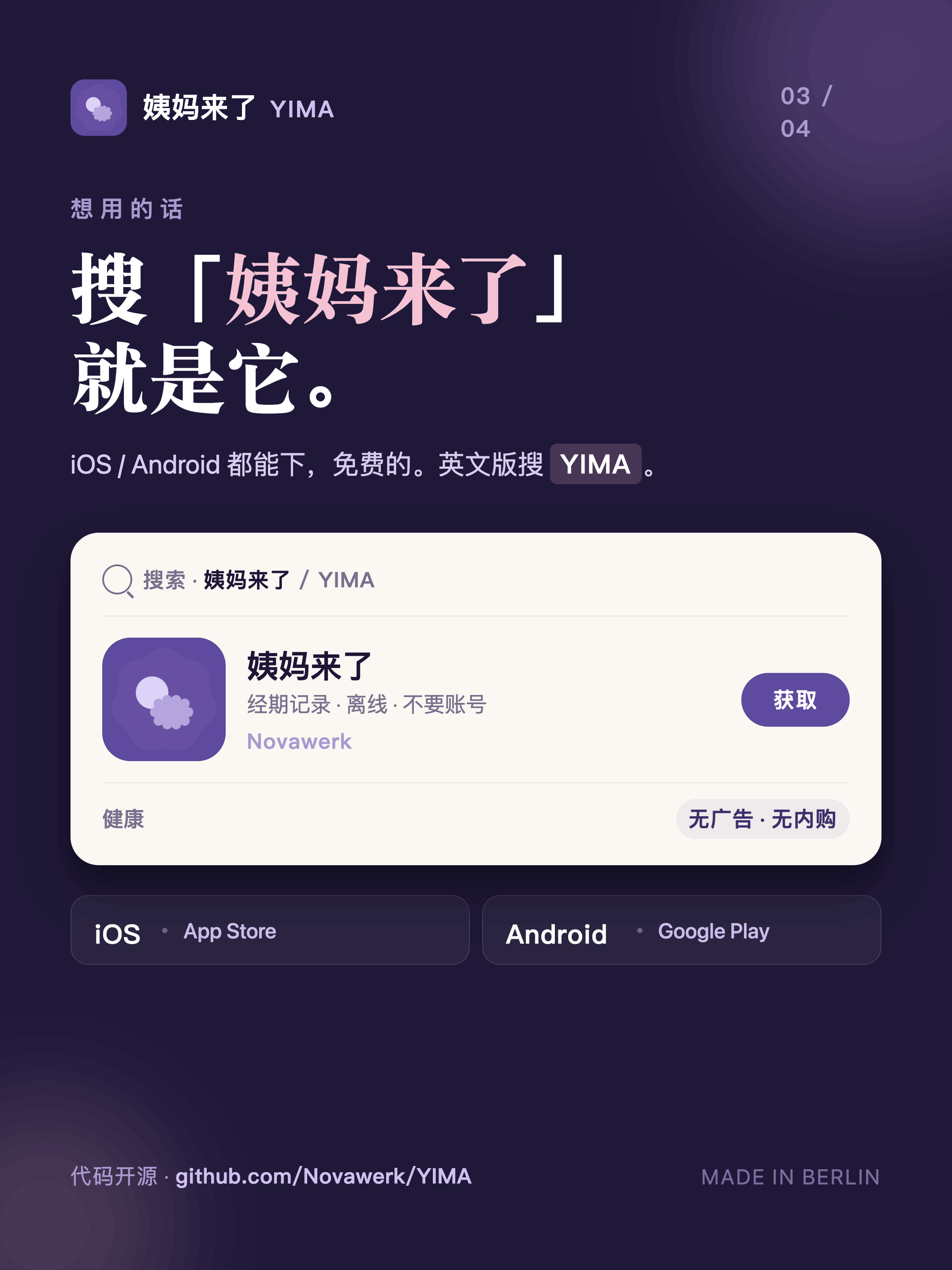
iOS is live on the App Store today; Android is on the way. Built by a handful of Novawerk volunteers in evenings and weekends — updates land at a deliberately unhurried, part-time pace, but the project is set up to be maintained for the long run.
Download on the App Store → · Source on GitHub →
YIMA is intended for personal cycle tracking only. It is not medical advice — please consult a doctor for any health concerns.
How it's going
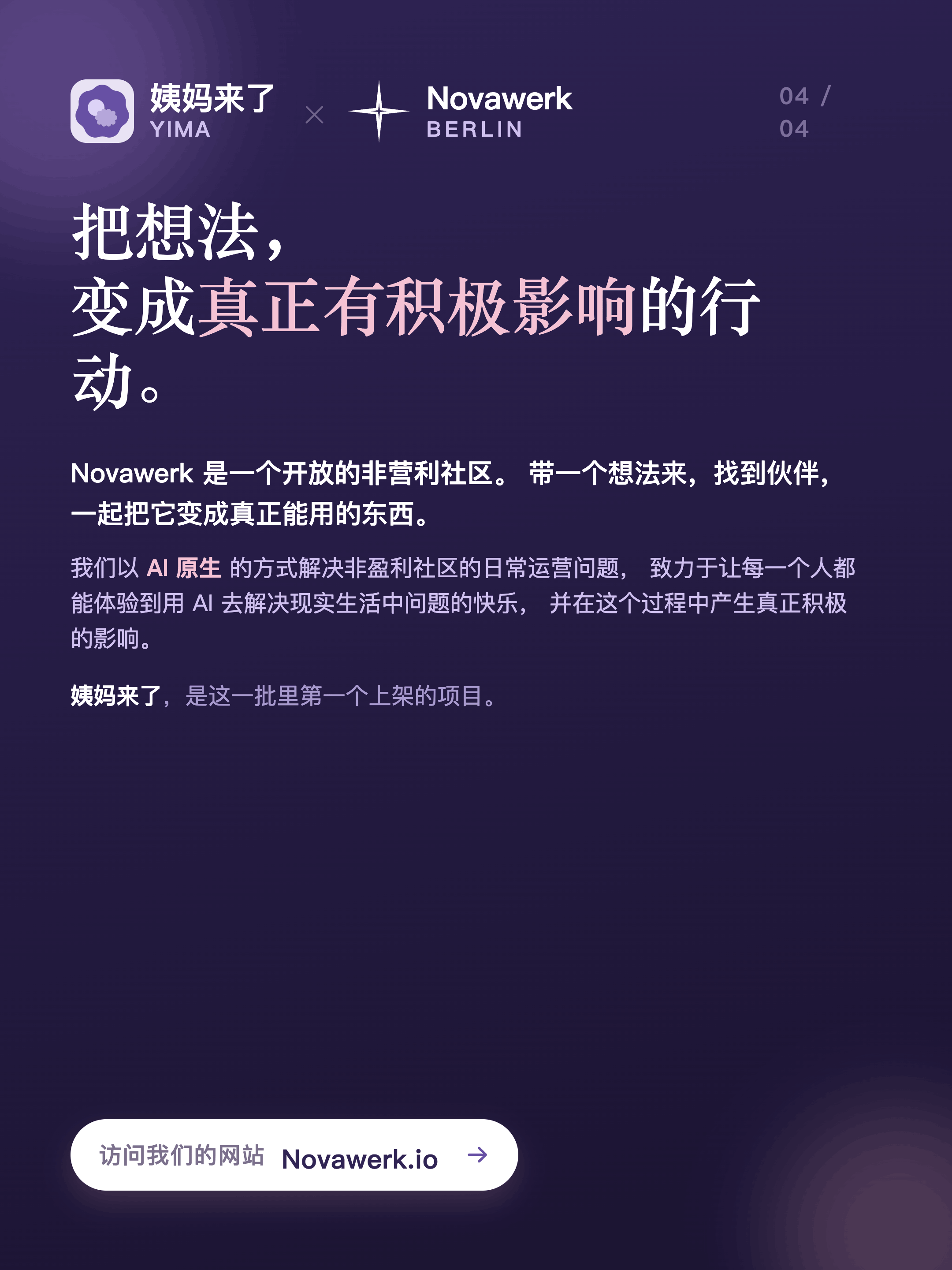
- Q4 2024YIMA idea pitched at a Novawerk open day. First collaborators commit a Saturday afternoon.
- Q1 2025Validation conversations with target users. Scope cut on purpose; the smaller version turns out to be the one people actually want.
- Q2 2025First measurable result: Privacy-first period calendar.. The team writes the playbook so others can replicate.
- Q4 2026Working with a partner organization to extend reach without losing the qualitative care that made it work.
“We didn't want a product launch. We wanted something that would still be here in three years — without us.”
Team & roles
Coordinates direction, runs weekly retros, talks to partners.
Owns the artifact — code, hardware, or the printed thing — depending on the week.
Shows up in person where the work meets the world.
Documentation, retros, community check-ins. Looking for someone.
Gallery
Get involved
If anything in here resonates — even just one paragraph — that's enough to start a conversation. Lightweight contribution is welcome. So is sitting in on a retro before you decide.